In many discussions about the future of Muslim communities, conversations often revolve around systems, governance, or power. Yet beneath all of these lies a more fundamental question that is not always clearly addressed: what kind of society are Muslims actually trying to build?
Without clarity on this, efforts can move in different directions. Some prioritise economic growth, others emphasise political influence, while others focus on identity or cultural preservation. Each of these may hold value in its own way, but without a shared vision of the desired outcome, progress can become fragmented and sometimes even contradictory.
Part of this confusion comes from the modern world itself. Today, societies are often shaped by competing models. Some prioritise economic progress above all else, others emphasise individual freedom, while others focus on equality or national identity. It is therefore natural for people to be drawn toward models that appear successful in specific areas. Yet each of these reflects only one dimension of what a healthy society requires.
When viewed through an Islamic lens, the question shifts. The focus is not primarily on constructing a system, but on nurturing a society grounded in values that shape how people live, interact, and organise their collective life. This way of thinking becomes clearer when we understand that Islam itself is not built around rigid ideological models, but around enduring principles and values, as explored in this earlier reflection.
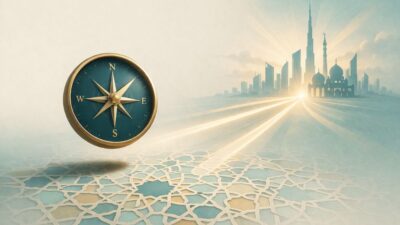
A helpful way to approach this is to think less in terms of systems and more in terms of environment. What kind of human environment allows individuals and communities to function with dignity, responsibility, and purpose?
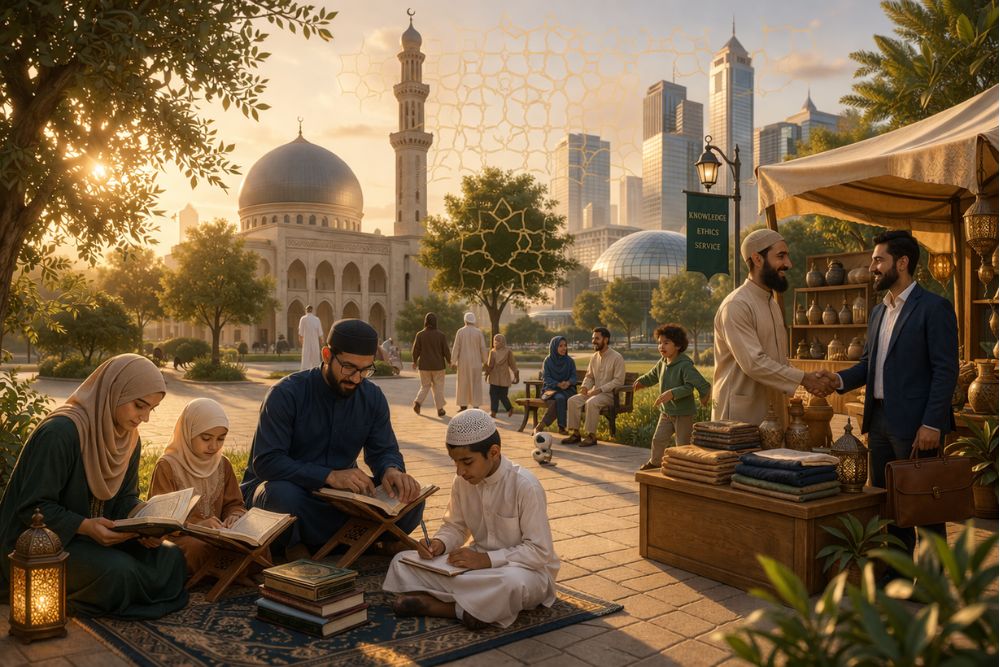
In such a society, justice would not be selective, but consistent. Trust would not be exceptional, but expected. Economic activity would be productive, yet guided by ethical responsibility. Knowledge would be pursued not only for personal advancement, but for the benefit of others. Institutions would function with accountability, and social relationships would be built on mutual respect.
This is not simply an abstract ideal. It is a direction that has been reflected in Islamic teachings and historical experience, where values were not confined to personal belief, but extended into everyday life. The strength of such a society does not lie in how it is labelled, but in how consistently these values are lived.
This understanding is also reflected in classical Islamic wisdom. It is reported that Ali ibn Abi Talib once said, “Truth is not known by men; know the truth and you will know its people.” In other words, what gives a society its strength is not the identity it claims, but the principles it upholds.
Perhaps the most important way to understand this is through how a society actually forms.
A healthy society is not produced by a single decision or structure, but through multiple layers working together.
Individuals develop character and responsibility.
Families nurture values and stability.
Institutions provide structure and accountability.
Over time, these layers reinforce one another, shaping a society that reflects coherence rather than contradiction.
This perspective also explains why focusing only on visible structures can be limiting. Systems are important, but they are ultimately reflections of the people within them. Without the underlying values, even well-designed systems may struggle to produce meaningful outcomes.
At this point, a natural question may arise. Can such a balanced vision function effectively in a fast-moving and competitive world? It may appear less forceful compared to models driven by rapid economic expansion or political dominance. Yet experience suggests that societies built on imbalance often struggle to sustain themselves, while those grounded in coherence and values tend to endure over time.
In today’s world, Muslim communities exist in diverse contexts. Some operate within majority settings, while others live as minorities. Some function within stable environments, while others face more complex realities. Despite these differences, the underlying objective remains consistent: to contribute to a society shaped by justice, balance, and human dignity.
This does not require a single uniform model. It requires clarity in principles and consistency in how they are applied. It also requires the ability to engage with existing systems thoughtfully, contributing positively while maintaining ethical integrity.
In practical terms, this means investing in education, strengthening institutions, supporting ethical economic activity, and fostering social cohesion. It also means developing individuals who are not only capable, but guided by values that shape how their capabilities are used.
Over time, such efforts contribute to a form of progress that is both meaningful and sustainable. It may not always be immediate or highly visible, but it is more likely to endure.
Ultimately, the question is not only about which systems are adopted, but about the kind of society that is consistently nurtured. When that vision is clear, decisions across governance, economics, and social life begin to align naturally.
In the end, it is not the structure of a society that determines its strength, but the values it lives by — consistently, quietly, and over time.
Disclaimer: This article reflects personal reflections based on Islamic teachings and historical understanding. It is intended for thoughtful discussion and does not represent political endorsement or criticism of any individual, group, or government.